
After years of litigation, the courts have finally demonstrated the correct way to apply the concept of mutuality of obligation, and HMRC were on the wrong side of it. Before getting into the details, I'll explain how we got here and my role in the mutuality case law journey.
At Gateshead Law Courts on 23-26 September 2019, I assisted Chris Leslie in defending the appellant of RALC Consulting v HMRC in an IT contractor IR35 case.
The night before the final hearing, we were drafting submissions into the early hours of the morning, ahead of the last day. I clearly drafted the mutuality submissions: there was no guaranteed offer or acceptance of work, no guaranteed payment if the work was not done, and no payment for simply being available. The tribunal agreed in unequivocal terms:
- "lack of contractual right or express guarantee of any hours or days of work"
- "no contractual guarantee or right to be offered a minimum of work"
- "expectation did not crystallise into any guarantee or legal obligation"
Those findings went directly to the absence of any ongoing mutual obligations. What followed was a legal relay race through the courts.
Bring in the referees (PGMOL)
The recently released decision in PGMOL result had its first hearing decision preceding RALC, published on 30 August 2018. HMRC appealed to the UT, which heard the case on 28/29 Jan 2020, after RALC. Chris attended the PGMOL Upper Tribunal hearing while I was away, and one of the PGMOL team congratulated us on advancing the mutuality argument at the First-tier Tribunal. At that stage, the lack of "full-blooded" mutuality was being treated as determinative, as it was in both RALC and the earlier PGMOL decisions.
HMRC sought an appeal of RALC to the Upper-tier Tribunal and PGMOL to the Court of Appeal. RALC sat waiting behind PGMOL. The PGMOL Court of Appeal clarified the principles of mutuality and their application, stating that, at the first stage of the 3-stage status test in Ready Mixed Concrete ("RMC"), mutuality meant only payment for work done. PGMOL appealed to the Supreme Court, arguing that the nature of the obligations was relevant.
HMRC continued to resist that position, and the Supreme Court dismissed their argument.
For years, HMRC have argued that mutuality meant nothing more than payment for work done. At the Supreme Court, HMRC's counsel advanced a more striking position: that, where both parties could cancel without sanction, the rights effectively "cancelled each other out" and were irrelevant. You will not find that phrasing in the written judgment, but you can watch it online on YouTube. You'll also see the judges firmly disagreeing with HMRC's curious submission, instead recognising that such features point away from subordination and indicate independent working.
In September 2024, the Supreme Court published its decision, ratifying the position stated by the Court of Appeal in the Atholl House decision on 22 April 2022 – a case I spent six years helping to defend successfully. The principles are that Stages 1 and 2 of RMC are merely pre-conditions, before moving to Stage 3, where a full multi-factorial assessment should be conducted, which should include the "nature and extent" of the mutual obligations, along with the "nature and degree" of control, together with all other relevant factors.
So, we now look at the PGMOL decision, six and a half years after RALC, and notice the following findings:
"there were no guarantee of appointments and no obligation on a referee to accept any appointment… The absence of any obligation to offer or accept work during the season points away from employment". ….this remained a "significant factor pointing away from employment".
As you can see, the absence of any obligation to offer or accept work, even in the context of regular engagements, was treated as a strong and significant indicator of non-employment. The law has always required consideration of the real nature of the parties' obligations. HMRC spent years arguing this was not the law. The courts have now confirmed that it is, and always has been.
Impact on HMRC's CEST Tool
So, what does HMRC's Status Tool (Check Employment Status for Tax) do?
The logic underlying the HMRC CEST tool has not been updated since November 2019, despite clarifications to the law in April 2022 and September 2024. We know how it works, because the source code and logic are published online by HMRC (although they did accidentally delete it at one point)
Nothing has changed in the case law since September 2024, and it is unlikely to change. The Supreme Court is our highest court; all courts below it must follow the law it lays down, and so does HMRC. All the contentious status arguments have been clarified. There is no need to go there again, and no cases are heading towards it.
For CEST users, you need to understand that CEST will only hand out an Outside IR35 determination based on the "pre-condition" checks defined in Atholl House (Stages 1 and 2). So, if there is no personal service at all, or no "sufficient framework of control." Those are very low bars in the world of status case law, and they were easily met in PGMOL. If the pre-condition checks do not give you an outside IR35 determination, CEST will always tell you "Indeterminate" or "deemed employment". It cannot do a proper RMC Stage 3 determination and tell you "self-employed", e.g., outside IR35.
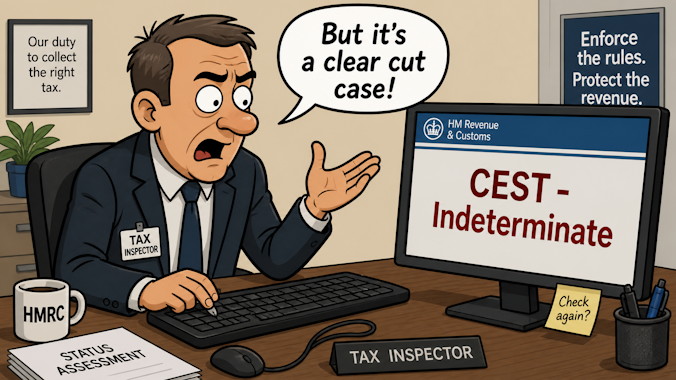
If you put PGMOL through the HMRC CEST tool, it will tell you "indeterminate" and state, "This outcome is typical when the information is finely balanced."
Yet, the judge described the PGMOL case as "not a finely balanced case" and that "taken cumulatively, the relationship lacks the defining hallmarks of employment." CEST was unable to discern a clear-cut case of self-employment. If a clear case like PGMOL cannot be correctly determined, that raises serious questions about reliability in more nuanced cases.
What happens next?
It seems highly unlikely that HMRC will seek to appeal the PGMOL decision to a sixth hearing.
Hopefully, HMRC will now update their online guidance (and their CEST tool) to align with the correct way to consider mutuality and control, and also reflect on any ongoing cases they are currently evaluating against the backdrop of a historically mistaken interpretation of the law.
For firms and contractors, the latest ruling should provide further legal clarity and certainty when hiring contractors.
[Update: 09/09/2026.HMRC did not appeal the PGMOL decision, which is now final. On mutuality, it splits into two parts. At RMC Stage 1 we just need to identify payment for work done. But at RMC Stage 3 will look at the nature and extent of the mutuality obligations. Mutuality is not determinative (HMRC were correct), but the lack of an ongoing obligation to offer/accept (particularly for shift-based working) can be a strong pointer away from employment - but it is not determinative. All other rights and obligations need to be considered, and the interplay of those rights with the nature and degree of control.]